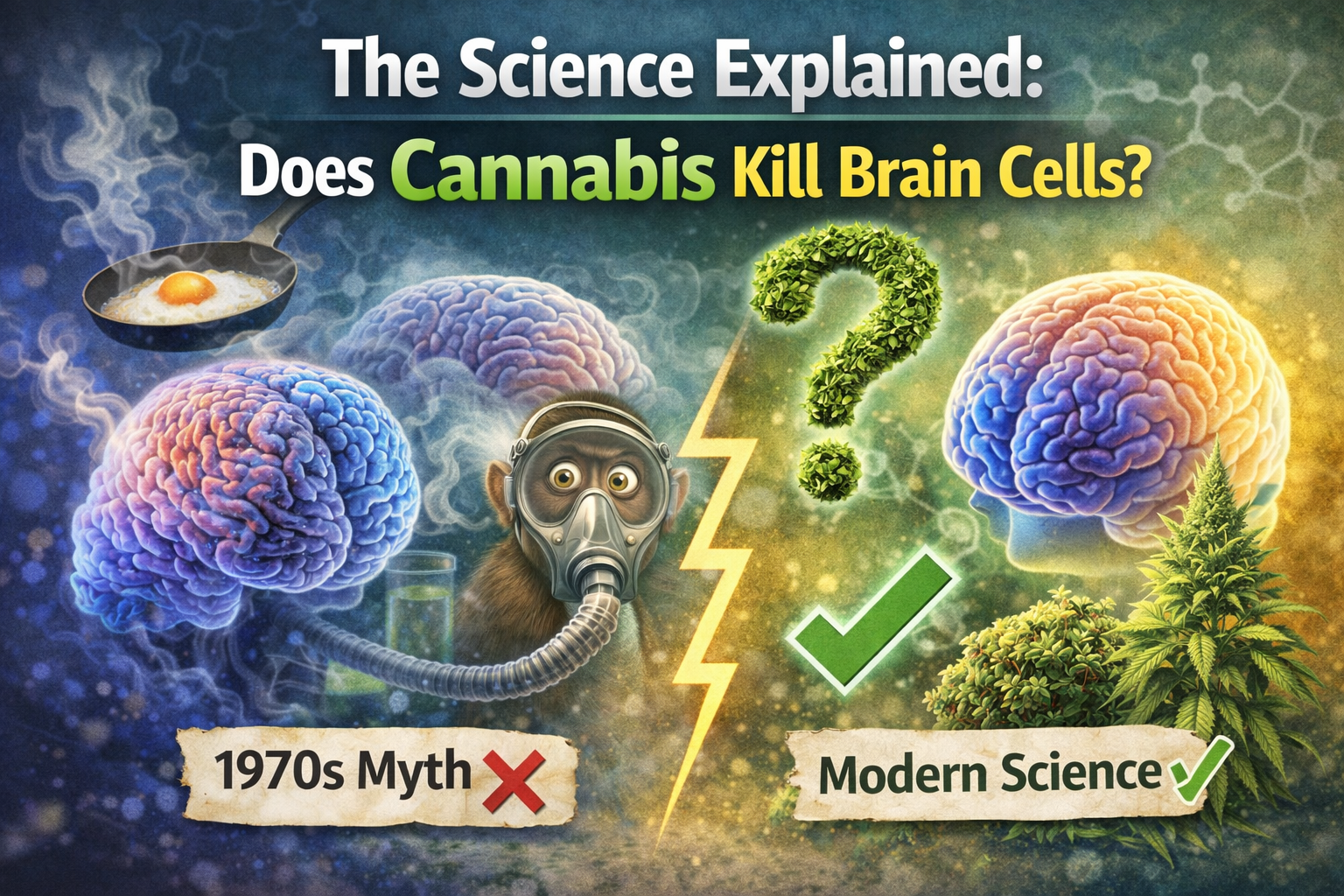
If you grew up in the 1980s or 1990s, you probably remember the infamous anti-drug campaigns. The central message was always the same: smoking weed will permanently fry your brain.
But does cannabis kill brain cells in reality? Having analyzed decades of neurological data, I can tell you that the short answer is no.
The Origin of the Brain Damage Myth
The idea that cannabis destroys brain tissue actually stems from a deeply flawed experiment from the 1970s.
In the infamous “monkey study,” researchers pumped massive amounts of cannabis smoke into gas masks worn by monkeys. The monkeys did indeed suffer brain damage and cell death. However, later investigations revealed a crucial flaw. The monkeys were not receiving any oxygen for up to five minutes at a time. The brain cells didn’t die from cannabis; they died from hypoxia (suffocation).
What Modern Science Actually Says
Modern neuroimaging and clinical studies paint a very different picture. Cannabis does not cause structural damage to the adult brain.
When you consume THC, it binds to cannabinoid receptors, temporarily altering how neurons communicate. This causes the feeling of being high and temporary memory fog. Once the THC leaves your system, those neurons return to their normal function. There is no mass die-off of brain cells.
The Developing Brain vs. The Adult Brain
While adult brains are safe from cell death, teenagers are a different story. The human brain continues to develop until around age 25.
Heavy, chronic cannabis use during adolescence can alter the way the brain wires itself, impacting the development of the prefrontal cortex (responsible for decision-making). This isn’t cell death, but it is an alteration of healthy development.
Reliable Source: The National Institute on Drug Abuse (NIDA) explicitly states that while cannabis temporarily impairs cognitive function, there is no solid evidence that it kills brain cells in adults.
Fun Fact: Some preliminary studies suggest that the endocannabinoid system might actually promote neurogenesis—the growth of brand new brain cells—in the hippocampus of older adults!
 hempcentral
Comments